
Stainless Steel H-Beam Selection for Corrosive and High-Load Environments
Navigating ASTM Standards, Surface Finishes, and Structural Durability in Stainless Steel H-Beam Distribution
For structural engineers, project procurement managers, and industrial metal distributors, sourcing a stainless steel H-beam involves balancing structural load capacity with long-term material lifecycle costs. Unlike traditional carbon options, a stainless steel H-beam is selected primarily for applications where structural integrity must coexist with exceptional resistance to chemical exposure, marine salinity, or extreme temperatures.
To ensure safety and achieve cost predictability on architectural and industrial builds, global buyers focus their sourcing efforts on manufacturers capable of delivering verified material grades, uniform cross-sectional dimensions, and reliable transport protection for every stainless steel H-beam batch.
1. Material Selection: Sourcing Common Stainless Steel H-Beam Grades
Material chemistry dictates the performance of structural profiles under environmental stress. Suppliers catering to international projects must offer precise control over alloying elements to meet standard stainless steel H-beam designations:
-
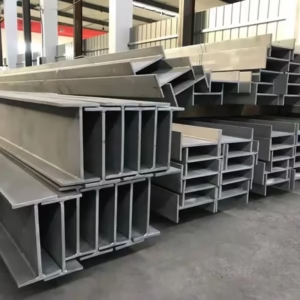
The Austenitic Baseline: For general industrial framing, food processing facilities, and water treatment infrastructure, the Grade 304 stainless steel H-beam is the standard selection. This grade provides a dependable balance of chromium and nickel, ensuring reliable atmospheric corrosion resistance and excellent weldability.
-
The Marine and Chemical Standard: When structural frames are exposed to chlorides or harsh chemical vapors, engineers specify the Grade 316 stainless steel H-beam. Formulated with added molybdenum, this stainless steel H-beam grade offers enhanced resistance to pitting and crevice corrosion, making it common in offshore oil platforms and pharmaceutical cleanroom supports.
-
The High-Strength Duplex Option: For heavy infrastructure demanding both high yield strength and stress corrosion cracking resistance, buyers turn to duplex families such as Duplex 2205. A stainless steel H-beam manufactured from duplex alloys allows engineers to reduce profile thickness and structural weight without compromising safety margins.
2. Manufacturing Precision: Addressing Dimensional Tolerances and Surface Finishes
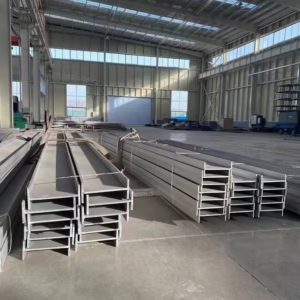
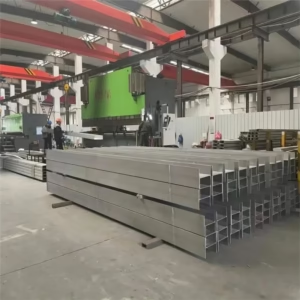
A frequent concern during the installation of a heavy stainless steel H-beam is sectional uniformity. These profiles are generally produced via hot-rolling, laser-fusing, or welding plate components together, and each method introduces distinct metallurgical factors.
[图片占位符 2:展示 Stainless Steel H-Beam 激光焊接(Laser Fused)工艺特写,或者数控抛光加工现场图]
During the cooling or welding phase, thermal gradients can cause minor flange tilt or cambering along the length of the section. If these tolerances are not managed within strict boundaries, the stainless steel H-beam may experience alignment difficulties during automated onsite bolt-hole matching or structural welding.
To mitigate these issues, advanced production facilities utilize precision straightening equipment and comprehensive dimensional inspections. Furthermore, suppliers offer various surface treatments for the stainless steel H-beam, including bead-blasting, acid pickling, or satin polishing, which help homogenize the surface and restore the passive chromium oxide layer necessary for corrosion defense.
3. Supply Chain Integrity: Logistics and Quality Certification
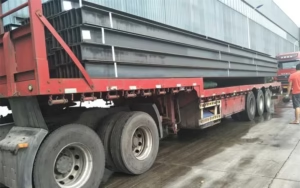
Because a stainless steel H-beam represents a higher initial capital investment compared to standard carbon steel, preventing surface contamination during international transit is a primary logistical focus. Contact with carbon steel tools or iron dust in transit docks can cause carbon contamination, leading to localized surface rusting.
| Stainless Steel H-Beam Grade | Key Performance Advantage | Primary Industrial Application |
| ASTM A276 / Grade 304 | Balanced Weldability, Cost-Efficient Corrosion Resistance | Food Processing Facilities, Architectural Framing, Water Treatment |
| ASTM A276 / Grade 316 | Molybdenum-Enhanced Pitting Resistance | Marine Infrastructure, Chemical Plants, Offshore Substructures |
To preserve material purity, suppliers implement strict handling protocols, utilizing nylon lifting slings instead of steel chains, and packing each stainless steel H-beam bundle with protective wooden skids or polymer wrapping. To facilitate customs clearance and engineering audits, every stainless steel H-beam shipment is accompanied by detailed Material Test Certificates (MTC EN 10204 3.1) confirming exact chemical composition and mechanical test results traceable to the original melt heat number.
Conclusion: Securing Stability in Stainless Steel H-Beam Sourcing
Succeeding in specialized structural distribution relies on minimizing material and logistical variables. By partnering with manufacturing experts who deliver verified global standard compliance, precise surface finishes, and strict contamination-free packaging, wholesalers and contractors can safeguard their project timelines throughout the stainless steel H-beam supply
Fabricant chinois d'acier inoxydable, fournissant des solutions d'approvisionnement en acier inoxydable aux clients mondiaux
Contactez-nous
YIER (TIANJIN) STEEL CO., LTD.
Vision et mission
Nous ne ménageons aucun effort pour nous concentrer sur l’innovation des produits en acier inoxydable et en alliage et sur le service client, en fournissant des solutions complètes d’approvisionnement en acier inoxydable et en alliage aux clients du monde entier.